

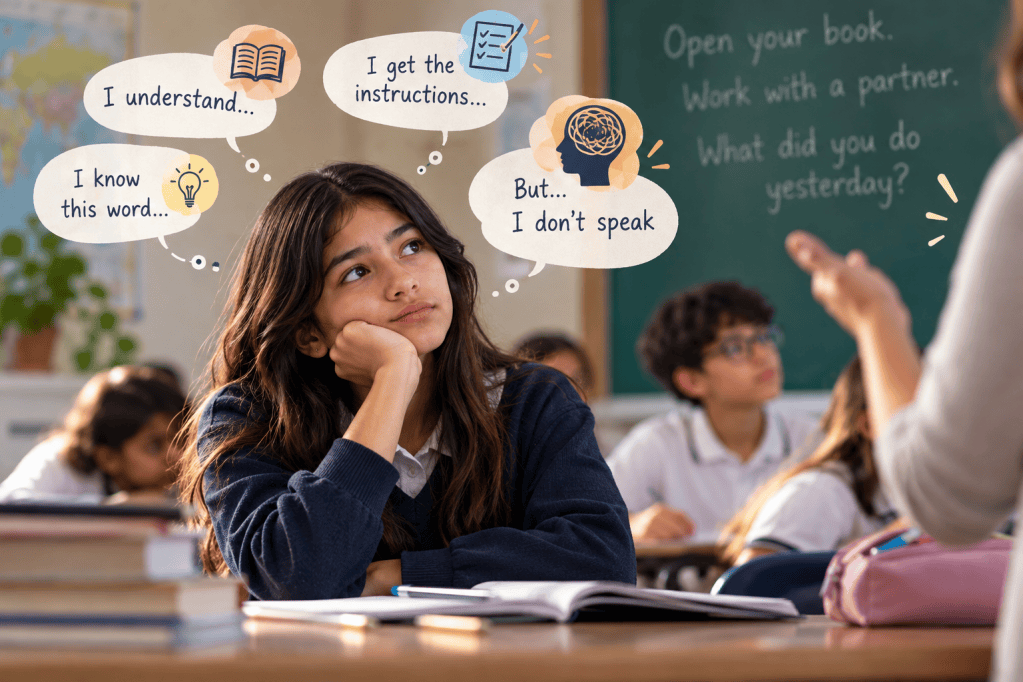
There is a moment many English teachers know very well.
You give an instruction and students understand it. You ask them to open the book, work with a partner or underline a word, and they respond correctly. They recognize vocabulary. They complete activities. Some can even follow the general meaning of a short conversation.
Then you ask a simple question in English.
Silence.
It is easy to feel that something is not working. If they understand, why are they not speaking?
The answer is not always simple, because understanding a language and producing it are connected, but they do not develop in exactly the same way.
Understanding often appears first
Language learning is not always visible. A student who remains quiet may still be recognizing patterns, connecting sounds with meanings and becoming familiar with recurring expressions.
Teachers sometimes see this when a student who rarely participates suddenly uses a phrase that has been heard in class for several weeks. The expression did not appear from nowhere. It had been developing quietly.
This does not mean that students should remain passive until they are ready to speak. It does mean that silence should be interpreted carefully.
Knowing vocabulary is not the same as using it
Many students can complete vocabulary exercises accurately and still struggle during spontaneous interaction. Knowing that apple, banana, rice and chicken are food words is one thing. Saying I usually eat rice for lunch, but I prefer chicken requires the learner to retrieve and combine language in real time.
Paul Nation’s work on the four strands of language learning is useful here. A balanced program includes meaning-focused input, meaning-focused output, language-focused learning and fluency development. Grammar and vocabulary instruction are part of the picture, but students also need repeated opportunities to use language for a purpose.
Some students know more than they are willing to say
A student may know the answer and still choose not to speak. Research on willingness to communicate has helped explain why language competence alone does not determine whether someone participates orally. Confidence, the situation, the people involved and the learner’s perception of risk can influence the decision to speak.
A student may talk freely with one friend but become completely silent when the same answer must be given in front of the whole class. Another learner may participate during a game and freeze during a formal presentation.
Limited exposure changes what we can reasonably expect
For many students, English exists mainly inside the classroom. They may have only a few lessons each week and almost no meaningful contact with the language outside school.
In these contexts, everyday classroom language can become particularly valuable: Can you repeat, please? I don’t understand. Can I borrow a pencil? It’s my turn. I agree. I think…
These expressions may look simple, but they give students something usable.
Repetition can help when it leads somewhere
Repetition is sometimes treated as old-fashioned, but the problem is usually not repetition itself. The problem is repetition without purpose.
A teacher can model I like pizza. Students repeat it, then change one element: I like tacos. A partner asks, What food do you like? The same structure is now being used to communicate.
Sometimes students need a few more seconds
Teachers often underestimate how much processing happens before a learner speaks. A question is asked. The student has to understand it, decide what to say, find the words and organize the response.
If the teacher fills the silence immediately, the learner loses the opportunity to complete that process. A short pause can change the interaction. So can pair rehearsal.
Before concluding that a student “cannot speak”
It helps to look at the conditions surrounding the task. Perhaps the student has not heard enough models. Perhaps the language needed for the response is still unfamiliar. Perhaps there has been plenty of explanation but very little actual speaking time. Or perhaps the student is afraid of making a mistake in front of others.
Teaching speaking is partly about creating conditions in which students can move from recognition to retrieval and from retrieval to communication.
Sometimes it begins with one familiar phrase used independently, then one short answer, then a brief exchange. One day, the student who usually listened decides to speak.
References
MacIntyre, P. D., Clément, R., Dörnyei, Z., & Noels, K. A. (1998). Conceptualizing willingness to communicate in a L2: A situational model of L2 confidence and affiliation. The Modern Language Journal, 82(4), 545–562. https://doi.org/10.1111/j.1540-4781.1998.tb05543.x
Nation, P. (2007). The four strands. Innovation in Language Learning and Teaching, 1(1), 2–13. https://doi.org/10.2167/illt039.0


Deja una respuesta